1939
Mbube (The Lion Sleeps Tonight, In The Jungle, Wimoweh) – Solomon Linda’s Original Evening Birds (Solomon Linda)
Written by Solomon Linda and recorded in 1939 by Solomon Linda’s Original Evening Birds under the original title ‘Mbube’. Since then it has been known variously as ‘Wimoweh’ and ‘The Lion Sleeps Tonight’. Adapted in 1951 by Paul Campbell with English words by Roy Ilene and recorded by The Weavers as ‘Wimoweh’.
Revised in 1961 by Hugo Peretti, Luigi Creatore, George Weiss and Albert Stanton and recorded by The Tokens, a New York-based folk, country-and-western teenbeat vocal quintet, who had a million-seller with this song re-titled ‘The Lion Sleeps Tonight’. It was US#1 for 3 weeks and reached #11 in the UK.
Recorded by Karl Denver in 1962 titled ‘Wimoweh’ and went to UK #4. It was recorded a few more times during the ’60s, notably by Bert Kaempfert, on his 1962 A Swingin’ Safari album, which reached UK #20 in 1966.
Recorded in 1971 by Robert John, and reached #3 on the US charts in January 1972. Again it sold over a million units. Also recorded in 1972 by Dave Newman and achieved UK #34.
Recorded by Tight Fit in 1982 and topped the UK charts. Tight Fit included SA’s own “Mr Knockout”, Richard Jon Smith, on backing vocals.
Appeared as a brief excerpt sung by Timon and Pumbaa in Disney’s animated classic The Lion King in 1994. Released as a full version by Lebo M in 1995 on the “Rhythm Of The Pridelands” CD – a cash-in release after the success of the Lion King movie.
U2, during their 1998 South African tour, played a short extract of ‘The Lion Sleeps Tonight’ during ‘Bad’.
1962
Ag Pleez Deddy – Jeremy Taylor (Jeremy Taylor)
Quite what the appeal of ‘The Ballad of the Southern Suburbs’ (or ‘Ag Pleez Deddy’ as it’s more affectionately known) is, is somewhat a mystery to me. It’s a very simple tune strummed on an acoustic guitar and sung by an ou who doesn’t have the greatest voice, yet this little ditty has made it’s way into South African musical folklore and is still regarded as a classic. Although I can’t put my finger on why, I, like thousands of other South Africans love this song, possibly it’s the reference to all those lekker things of one’s youth like candy floss and eskimo pies that keep this song fresh and alive.
John Samson, November 2000
This song was taken from a live recording of the stage musical ‘Wait A Minim’ in 1962. It was banned by the SABC (as were most of Jeremy’s songs). It reached #1 on the LM radio charts in June 1962. Jeremy received a gold disc for over 75 000 units sold of ‘Ag Pleez Deddy’ – s’true’s bob. (Info from the sleeve notes for “The Best Of SA Pop Volume 1” CD written by Malcolm Lombard)
1965
Hungry For Love – The A-Cads (Johnny Kidd)
The A-Cads were a great South African rock and roll band formed in Johannesburg in 1965. They had a Springbok #1 hit in January 1966 with a cover of the Johnny Kidd and The Pirates’ ‘Hungry For Love’.
1967
Time And The River – The Dream Merchants (Tiomkin / Washington)
A cover of the Nat ‘King’ Cole classic in the style of the Righteous Brothers ‘Unchained Melody’.
1968
Master Jack – Four Jacks And A Jill (David Marks)
Glenys Lynne (born 5 May 1945): vocals/ Bruce Bark: lead guitar/ Till Hanneman: rhythm guitar/ Tony Hughes: drums / Clive Harding: bass
Written by David Marks (real name: Spiros D Markantonatos) of his experiences as a young man working in the mines, this song went out from South Africa to the world. ‘Master Jack’ was released on 5 January 1968 and entered the Springbok Top 20 at #14. It remained on Springbok’s Top 20 for twenty-one weeks, was #1 for five weeks during February and March of 1968, and for three weeks in March was #1 in Rhodesia.
Four Jacks and a Jill were the first South African group to have three hits in the Top 20 at the same time: ‘Timothy’, ‘Master Jack’, and ‘I Looked Back’. ‘Master Jack’ was also a hit in America, reaching #18 in June 1968, according to Billboard’s Hot 100.
Sources: Liner notes from ‘The Best of SA Pop Volume 2’ and ‘The Very Best of Four Jacks and a Jill, Volume One’, both written by Malcolm Lombard – info kindly supplied by Kurt Shoemaker, October 1999
Four Jacks and a Jill — Master Jack — RCA Victor 47-9473
Kurt Shoemaker, USA, October 1999 (info from Both Sides Now website)
This is the original South African recording, in mono only. RCA, on the success of the 45, flew the group to L.A. and recorded the stereo LP. All reissues of this song have been the stereo remake.
This song seems to float down from the sky on the hypnotically repetitive plucked guitar. Glenys Lynne’s beautiful voice is haunting as she sings the enigmatic yet meaningful lyrics. A lovely and timeless song.
Kurt Shoemaker, USA, October 1999
Four Jacks and a Jill achieved the distinction of being the only South African group to have had a hit in America with a single recorded in South Africa.
The History of Contemporary Music of South Africa, 1994
‘Master Jack’ went as high as #18 on the Billboard Hot 100. It achieved #3 on the Billboard Easy Listening charts.
Lyrics
It’s a strange, strange world we live in, Master Jack
You taught me all I know and I’ll never look back
It’s a very strange world and I thank you, Master Jack
You took a coloured ribbon from out of the sky
And taught me how to use it as the years went by
To tie up all your problems and make them look neat
And then to sell them to the people in the street
It’s a strange, strange world we live in, Master Jack
You taught me all I know and I’ll never look back
It’s a very strange world and I thank you, Master Jack
I saw right through the way you started teaching me now
So some day soon you could get to use me somehow
I thank you very much and though you’ve been very kind
But I’d better move along before you change my mind
It’s a strange, strange world we live in, Master Jack
You know how I feel as if I’ll never come back
It’s a very strange world and I thank you, Master Jack
You taught me all the things the way you’d like them to be
But I’d like to see if other people agree
It’s all very interesting the way you disguise
But I’d like to see the world through my own eyes
It’s a strange, strange world we live in, Master Jack
No hard feelings if I never come back
You’re a very strange man and I thank you, Master Jack
You’re a very strange man and I thank you, Master Jack
You’re a very strange man and I thank you, Master Jack
Words and Music by Spiro D. Markantonatos (Dave Marks)
Transcribed by Robin Hood
Eclipse – Freedoms Children (Ramsay MacKay / Harry Poulos)
Ramsay MacKay: bass, vocals/ Julian Laxton: guitars/ Colin Pratley: drums/ Nic Martens: keyboards/ Pete Clifford: guitar/ Dennis Robertson: vocals/ Stevie van Kerken: vocals/ Steve Trend: vocals/ Peter Vee: vocals/ Harry Poulos: keyboards/ Brian Davidson: vocals (unconfirmed)

This epic tune was released as a single in 1968, and the following year it appeared on the Battle Hymn Of The Broken-Hearted Horde album.
For Your Precious Love – The Flames (Jerry Butler/ Joe Brooks/ Arthur Brooks) [3.20]
Steve Fataar: guitar, vocals/ Brother Fataar: bass, vocals/ Baby Duval: guitar, vocals/ Blondie Chaplin: guitar, vocals/ Ricky Fataar: drums
“For Your Precious Love” was #1 on the Springbok Radio charts in October 1968 and spent 11 weeks in the Top Twenty. This classic emotional love song with its spoken introduction will always be associated, by South Africans, with Durban-based band The Flames. However many people are unaware that is was originally sung by Jerry Butler and The Impressions in 1958. The Impressions also featured Curtis Mayfield in their line-up.
Cry To Me – The Staccatos (Bert Russell) [4.00]
Steve Lonsdale: vocals/ Brian le Gassick: vocals, guitar/ Eddie Boyle: bass/ Gary Chaplin: drums/ Richard Crouse: guitar
This major contribution to SA’s pop history was an adaption of a Bert Russell composition which has been recorded by many others including Solomon Burke (1962), Tom Petty, The PrettyThings, The Rolling Stones, Freddie Scott and Betty Harris. Bert Russell is really Bert Berns, a prolific writer of soul classics.
The Staccatos recorded their version of ‘Cry To Me’ in 1968 for the movie Katrina, which was released in 1969. ‘Cry To Me’ was produced by Billy Forrest and proved to be one of South Africa’s most successful singles ever, reaching #1 in February 1969 and remaining 38 weeks on the charts and earning a double gold disc.
1970
Aimless Lady – Suck (Mark Farner)
Stephen Gilroy: guitar/ Saverio “Savvy” Grande: drums/ Louis Joseph Forer: bass/ Andrew Ionnides: flute and vocals
A cover of a song on Grand Funk Railroad’s ‘Closer To Home’ album. Released by Suck as a single in 1970 and on Suck’s only album Time To Suck also in 1970. Suck were the “heaviest of the heavies” and a very colourful band. Their covers included songs by Black Sabbath, Deep Purple and King Crimson.
Fever – Otis Waygood Blues Band (John Davenport / Eddie Cooley)
Rob Zipper: vocals, guitars, saxophones/ Ivor Rubenstein: vocals, percussion/ Leigh Sagar: guitars, organ/ Martin Jackson: vocals, flute/ Alan Zipper: bass
Like Uriah Heep and Jethro Tull, there is no actual person in the band called Otis Waygood. Rumours exist that a certain lift company was the inspiration for the name…who knows? But “Blues Band” says their name and flute-, sax- and harmonica-driven blues is what they played. Originating in Zimbabwe (then known as Rhodesia), the band moved to South Africa in November 1969 and released their first, self-titled album in 1970.
Garth Chilvers, co-author of the book, The History Of Contemporary Music Of South Africa (TOGA, 1994), rates Fever as “one of the finest singles ever to be released in this country”. Fever was originally recorded by Little Willie John in 1956 and sold over a million copies. It was co-written by John Davenport who’s real name is, wait for it… Otis Blackwell. He also co-wrote the rock and roll classics “All Shook Up” and “Great Balls Of Fire”. “Fever” was also a million-seller for Peggy Lee when she recorded it in 1958. “Fever” has been covered a number of times by artists as diverse as Elvis Presley, Madonna, the McCoys and Helen Shapiro.
1971
The Seagull’s Name Was Nelson – Des and Dawn Lindberg (Peter E Bennett)
Des Lindberg: vocals, guitar/ Dawn Lindberg (nee Silver): vocals, guitar
This anti-pollution protest song (and an oblique reference to Nelson Mandela, residing on Robben Island at the time) reached #4 on the Springbok charts in July 1971 and stayed 12 weeks in the Top Twenty. Des and Dawn won the SARIE award for Best Vocal Group in 1971 (and again in 1973). Pure political folk. This song strikes me as nearly as powerful and timely a song as Bright Blue’s ‘Weeping‘. When originally released, was anyone in doubt as to what it was about?
Kurt Shoemaker, July 2000
Here Comes The Sun – Hawk (George Harrison)
Dave Ornellas: Vocals, guitar, percussion/ Mark “Spook” Kahn: Guitar/ Brahm Malherbe: Drums/ Richard Johnson: bass/ Keith Hutchinson: sax, flute, piano
Before Osibisa or Juluka, Hawk pioneered combining classical, folk, jazz, progressive rock and traditional African styles into a unique and original sound. This track, a reworking of the George Harrison-penned Beatles classic, was number 78 in the LM Radio top hits of 1972. It was taken from their classic album African Day released in 1971.
Dave Ornellas became a pastor in the His People church in the Southern Suburbs of Cape Town. He passed away on the 8th September 2010. His children, Danny and Bashara have recorded gospel rock music under the name Naked Lyric.
1972
1999 – Freedoms Children
Julian Laxton: guitar/ Colin Pratley: drums/ Barry Irwin: bass/ Brian Davidson: vocals
This classic track was released on the 3rd Freedoms Children album, Galactic Vibes, after Ramsay MacKay had already left South Africa’s most original progressive rock band.
‘1999’ was re-recorded in 1998 by the Brian Davidson Band and released on the Various Artists compilation CD ‘Cape Town Vibes’.
Orang Outang – Hawk
Dave Ornellas: Vocals, guitar, percussion/ Mark “Spook” Kahn: Guitar/ Les “Jet” Goode: Bass/ Julian “Ipi” Laxton: Guitar/ Ivor Back: Drums/ Braam Malherbe: Percussion/ Billy “Knight” Mashigo: Percussion, vocals/ Audrey Motaung: Vocals, percussion/ Pete Kubheka: Vocals, percussion
“Orang Outang” (sometimes styled as “Orang-Outang”, “Orangoutang”, “Orang Otang” and “Ourang-Outang”) was written by Ramsay MacKay and originally recorded in 1971 by Freedom’s Children with Malombo Jazz Makers, but only released in 2020.
“Orang Outang” was first released as a single by Hawk in 1972. It has been recorded by Margaret Singana, Kenny Henson’s Harambee, Finch & Henson, Joy, Brian Finch and others. The version by Finch & Henson on their Recycled album is very similar to the track by Harambee, however Brian Finch’s vocals have replaced the voice of Margaret Modisell.
Ramsay MacKay’s “Orang Outang” is unrelated to two different songs with the same title by Jane Birkin & Serge Gainsbourg (1969) and Bow Wow Wow (1981).
Brian Currin
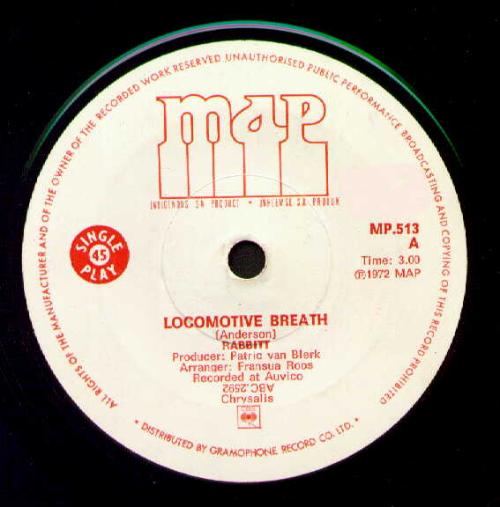
Locomotive Breath – Rabbitt (Ian Anderson)
1972: Trevor Rabin: vocals, guitars/ Errol Friedman: guitar/ Fransua Roos: keyboards/ Lou Forer: bass/ Cedric Samson: drums
1975: Trevor Rabin: vocals, guitars, keyboards/ Duncan Faure: guitars, keyboards/ Ronnie Robot: bass/ Neil Cloud: drums
This Jethro Tull classic, from their 1971 Aqualung album, was recorded in South Africa by a session band and released in 1972 as a single under the name “Rabbitt”. It reached #11 on the Springbok Radio Charts in February 1973 and was number 96 in the LM Radio Top Hits of 1972. I guess you could say it was a runaway smash!
Patric van Blerk had engaged Trevor Rabin (then only 18 years old) on a session to play guitar on a version of Jethro Tull’s Locomotive Breath he had wanted to do. The recording session had Errol Friedman playing guitar (Ronnie Robot’s brother), Fransua Roos on keyboards (who did the arrangement), Lou Forer (from Suck) on bass and Cedric Samson on drums. The lyrics were “cleaned-up” for the SA censors: “his woman and his best friend” were now “travelling to the sun” and “the all-time winner” had got him by … “the hands”!
When Rabbitt re-recorded this track in 1975 for their debut Boys Will Be Boys! album, the original Jethro Tull lyrics returned; a very brave move at the time!
1974
Miss Eva Goodnight – Crocodile Harris (Mike & Tully McCullagh)
Crocodile Harris (Robin Graham): vocals/ Richard Black: lead guitar/ Mike McCullagh: drums/ Richard Wilson: keyboards/ Tully McCullagh: bass
Classic haunting pop song with superb backing from McCully Workshop.
1975
Hard Ride – Rabbitt (Trevor Rabin)
Trevor Rabin: vocals, guitars, keyboards/ Neil Cloud: drums, percussion/ Duncan Faure: lead vocals, keyboards/ Ronnie Robot: bass/ Godfrey Rabin: violin solo
The Boys Will Be Boys! album (from which this track is taken) became a gold record (25 000 copies sold) faster than any other South African record.
Godfrey Rabin (Trevor’s father, who passed away in 1999) played the incredible violin solo on this driving rock song.
Lifeline – Rabbitt (Rabin / Van Blerk)
Trevor Rabin: vocals, guitars, keyboards/ Neil Cloud: drums, percussion/ Duncan Faure: lead vocals, keyboards/ Ronnie Robot: bass
The first Rabbitt track I heard off the Boys Will Be Boys! album. I seem to remember hearing it in a supermarket and thinking it was a new Queen song. Slow and powerful… I was hooked.